Blog
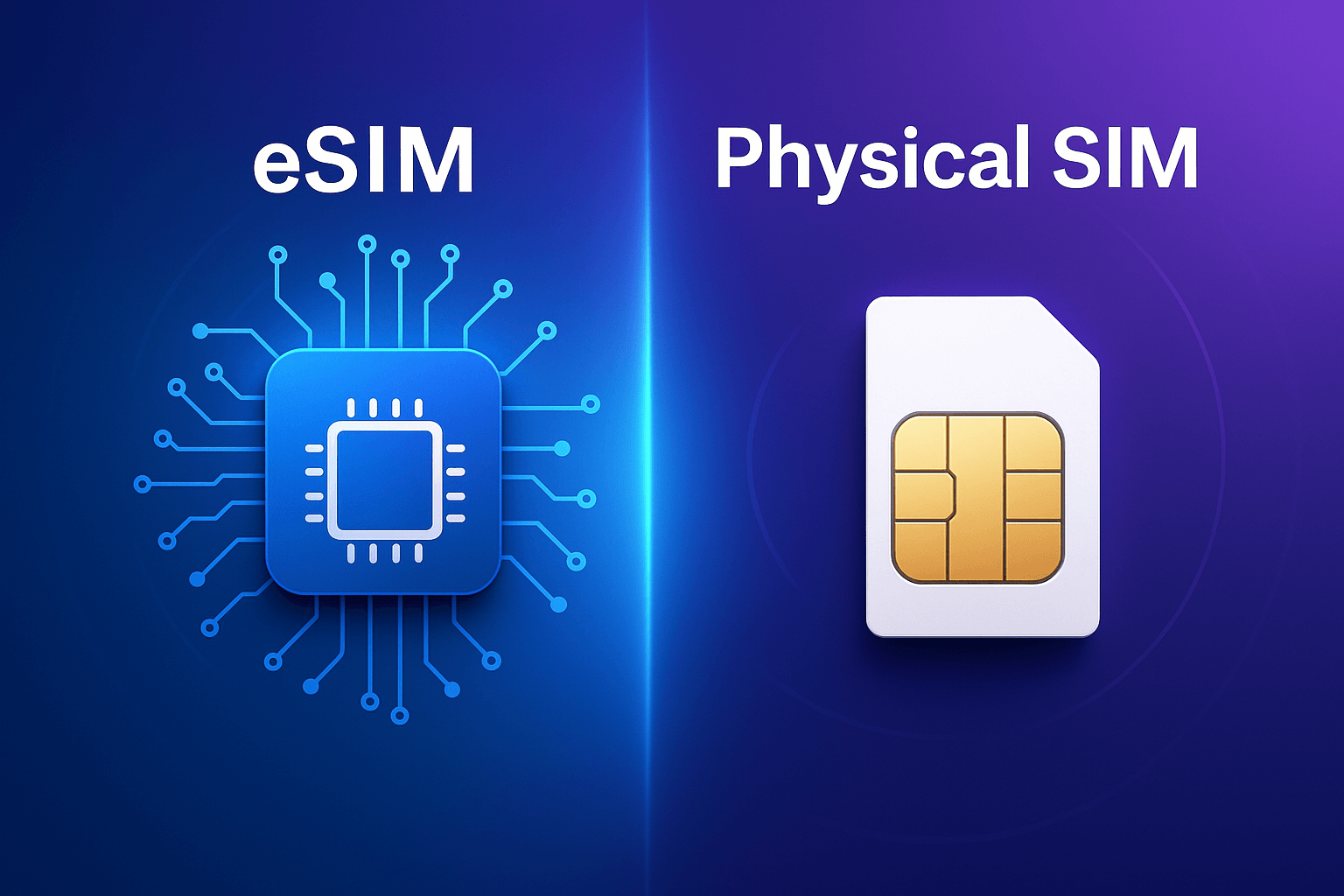
eSIM or Physical SIM: Which One Works Best for You in 2025?
In Internet jargon we often use the terms
bandwidth and Internet speed, and people often confuse the two, even though
they are very important terms, especially when it comes to choosing your
Internet features. What do these terms really mean and how do they influence
our online experiences? Let's delve into the subtleties of bandwidth and
internet speed to unravel the mysteries behind a smooth online connection.
1.
Understanding
bandwidth
Imagine your internet connection as a pipeline through which data flows.
This pipeline has a certain capacity to carry information, and that capacity is
referred to as bandwidth. Bandwidth is measured in bits per second (bps),
kilobits per second (kbps), megabits per second (Mbps), or even gigabits per
second (Gbps). Essentially, it represents the maximum rate at which data can be
transmitted over your network.
Higher bandwidth allows for a larger volume of data to flow through the
pipeline at any given time. It's akin to widening a road to accommodate more
vehicles, ensuring smoother traffic flow. This increased capacity becomes
crucial when dealing with data-heavy tasks like streaming high-definition
videos, online gaming, or large file downloads.
For a slightly more technical understanding of bandwidth:
At its core, bandwidth represents the maximum rate of data transfer
across a network. It's the breadth of the digital highway, and understanding
its multiple dimensions can shed light on the potential of your internet
connection.
Upstream and Downstream Bandwidth: Bandwidth isn't a monolithic entity; it can be divided into upstream
(upload) and downstream (download) components. Upstream bandwidth determines
how fast your device can send data to the internet, while downstream bandwidth
dictates the speed at which your device can receive data. A harmonious balance
between these two facets is essential for a well-rounded online experience.
Symmetrical vs. Asymmetrical Bandwidth: Some internet connections boast symmetrical
bandwidth, where the upload and download speeds are equal. This configuration
is ideal for tasks that demand consistent data flow in both directions, such as
video conferencing or online collaboration. On the other hand, most residential
connections offer asymmetrical bandwidth, prioritizing faster download speeds
for content consumption.
2.
Internet
speed
Internet speed is the measure of how quickly data can travel between
your device and the internet. It's often expressed in terms of download speed
and upload speed, both measured in Mbps.
Download Speed: This is
how fast your device can receive data from the internet. It's the critical
factor when streaming movies, music, or loading web pages. A higher download
speed ensures that content appears swiftly, reducing buffering times and
enhancing the overall user experience.
Upload Speed: On the
flip side, upload speed determines how fast your device can send data to the
internet. This becomes essential for activities like video conferencing, online
gaming, or uploading large files. A robust upload speed guarantees that your
contributions to the internet are transmitted without delays.
Factors that can influence your Internet speed:
Latency: Often
overlooked but critical for activities like online gaming and video
conferencing, latency measures the delay between the initiation of a request
and the receipt of the corresponding response. Low-latency connections
contribute to a more responsive online environment.
Jitter: Jitter is the
variability in latency, representing the inconsistency in the time it takes for
data packets to travel from one point to another. A low-jitter connection
ensures a smoother, more stable online experience.
Packet Loss: In the
journey of data from source to destination, packet loss occurs when some pieces
of information fail to reach their destination. Minimizing packet loss is
crucial for maintaining the integrity of real-time applications and preventing
disruptions in online communication.
3.
Other
factors that can influence your internet speed and bandwidth.
Network Congestion:
Picture a highway during rush hour; the increased traffic can slow down the
flow of vehicles. Similarly, network congestion occurs when many users are
simultaneously accessing the internet, affecting the speed and responsiveness
of your connection.
Quality of Service (QoS):
Internet Service Providers (ISPs) may prioritize certain types of traffic to
ensure a smoother experience for users engaged in activities that require low
latency, such as online gaming or video streaming.
Equipment Quality: The
router, modem, and other networking equipment play a crucial role in
determining the efficiency of your internet connection. Upgrading to
high-quality equipment can contribute to better overall performance
We hope you have found this Blog useful in understanding the different
elements that play an important role in the quality of your Internet, and we
would like to inform you that IVC telecom provides one of the best
Internet services with the best prices on the market. To consult our offers:
https://www.ivctel.com/Internet.